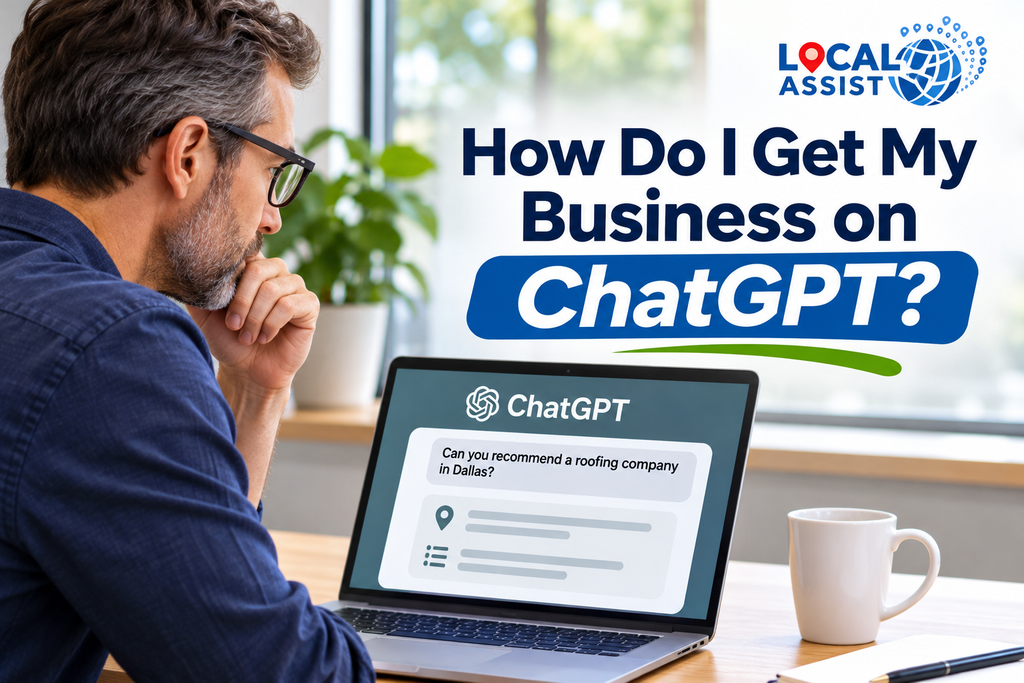
Wondering how to get your business on ChatGPT? Learn how AI discovers businesses, what information matters, and practical steps to improve your visibility.
To help your business get discovered through ChatGPT, make sure your website clearly explains what you offer, where you operate, and who you serve. Keep your business information consistent across reputable online listings, publish helpful answers to customer questions, and make your website accessible to search engines and AI search tools. No single registration guarantees that ChatGPT will recommend your business.
If you own a small business, you’ve probably spent years hearing about Google rankings, SEO, and getting your website onto the first page of search results.
But now there’s another question business owners are starting to ask:
How do I get my business on ChatGPT?
It’s a reasonable question.
People are increasingly using AI assistants to research products, compare services, and explore businesses before making a decision.
Instead of searching for “best cleaning company near me” and clicking through several websites, someone might ask ChatGPT:
“Can you recommend a reliable house cleaning company in Houston that offers move-out cleaning?”
The customer may receive an explanation, a list of potential providers, or suggestions for what to look for.
So how does your business become part of that conversation?
Let’s look at what you can actually do.
1. Understand How ChatGPT Finds Business Information
First, it’s important to understand that ChatGPT isn’t simply another business directory.
There isn’t one universal form where every business can register and automatically become a recommended provider.
Depending on the question and available features, ChatGPT may answer using its existing knowledge, retrieve information from the web, or use other available sources.
That means your business’s online presence matters.
If your website doesn’t explain your services clearly, or your business information is difficult to verify, an AI assistant may have less useful information to work with.
For example, consider two landscaping companies.
The first website says:
“Professional landscaping services. Contact us today.”
The second explains:
“We provide residential lawn maintenance, landscape design, and seasonal yard cleanup for homeowners in Sugar Land and nearby Houston communities.”
The second description gives readers and automated systems more specific information about the business.
It identifies the services, customers, and service area.
That clarity is a useful starting point.
2. Make Sure Your Website Clearly Explains Your Business
One of the most practical things you can do is review your website from the perspective of a potential customer.
Imagine someone visiting your homepage for the first time.
Can they immediately understand what you do?
Can they tell where you operate?
Can they identify whether your services match their needs?
If the answer is no, your website may need clearer information.
At a minimum, your website should explain:
- Your business name and primary services.
- The cities or communities you serve.
- The types of customers you work with.
- Your qualifications, experience, or relevant specialties.
- How customers can contact or book your services.
You don’t need to fill every page with keywords.
You need to communicate useful, accurate information.
For businesses serving multiple areas, dedicated location pages may help when those pages contain genuinely relevant details rather than repeated text with different city names.
The goal is to make your business easy to understand.
3. Answer the Questions Your Customers Are Already Asking
Think about the questions you receive from customers every week.
A house cleaning company might hear:
“Do I need to be home during the cleaning?”
“Do you bring your own cleaning supplies?”
“How much does a move-out cleaning cost?”
A CPR training business might hear:
“What’s the difference between AHA and Red Cross certification?”
“How long does CPR certification last?”
“Can I complete CPR training online?”
These are excellent topics for useful website content.
When you publish clear, accurate answers, you’re helping potential customers make informed decisions.
You’re also making more information about your business and expertise available online.
What should you create?
Start with a frequently asked questions page.
Then consider writing individual articles for questions that need more explanation.
For example, instead of publishing a generic article titled “The Importance of Professional Cleaning,” a cleaning company could write:
“What Is Included in a Move-Out Cleaning Service?”
That article can explain what’s typically included, what varies by provider, how customers should prepare, and what questions to ask before booking.
This is useful whether someone discovers the article through Google, an AI search tool, or a social media link.
Helpful content serves more than one purpose.
4. Keep Your Business Information Consistent Across the Internet
Your website isn’t the only place customers may encounter your business.
Your information may also appear on Google Business Profile, industry directories, professional associations, review platforms, and social media accounts.
Check that your core business details are accurate.
This includes your business name, website, contact information, locations, and services.
For example, if your website lists one phone number but several directories show an outdated number, customers may have difficulty contacting you.
Outdated or conflicting information can also make your business harder to understand.
Where should you start?
Review your Google Business Profile.
Then check the most relevant directories for your industry.
A restaurant might prioritize its official website, Google Business Profile, and major restaurant directories.
A contractor might prioritize reputable local directories, professional associations, and relevant licensing information.
You don’t need hundreds of low-quality directory listings.
Focus on accurate, trustworthy sources that genuinely matter to your customers.
5. Make Sure Your Website Can Be Accessed and Understood
A beautiful website isn’t very helpful if important pages are inaccessible.
Search engines and AI-powered tools may rely on publicly available website content to retrieve information.
If your website blocks relevant crawlers, has broken pages, or hides important details in inaccessible formats, that can limit how information is discovered.
You can ask your website developer to review:
- Whether important pages can be crawled.
- Whether the website has indexing problems.
- Whether service pages have clear headings and descriptive content.
- Whether the site works properly on mobile devices.
- Whether business details are available as readable text.
- Whether appropriate structured data accurately describes the business.
Structured data can help eligible systems interpret information about your organization, services, and location.
However, adding structured data doesn’t guarantee a recommendation from ChatGPT.
The priority is making accurate information available in a technically accessible format.
6. Demonstrate Real Experience and Credibility
Customers want to know whether they can trust a business.
AI assistants also need reliable information when responding to questions.
One way to strengthen your online presence is to demonstrate genuine expertise.
For example, a driving school could publish detailed explanations of its approved courses, eligibility requirements, and registration process.
A cleaning company could explain its cleaning methods, service limitations, and preparation instructions.
A restaurant could provide accurate menus, opening hours, location details, and information about dietary accommodations.
Other useful credibility signals include relevant professional credentials, authentic customer reviews, verifiable awards, and clearly identified business ownership.
Only publish claims you can substantiate.
Avoid creating fake testimonials, exaggerated experience statements, or articles that imply qualifications you don’t have.
Trustworthy information is more valuable than inflated marketing language.
7. Test Whether ChatGPT Can Find Your Business
Once your website and online information are in good shape, you can begin testing.
Open ChatGPT and ask questions that resemble what your potential customers might ask.
For example:
“Can you recommend a commercial cleaning company in Sugar Land, Texas?”
“Which CPR training providers offer classes in the West Valley of Phoenix?”
“What should I look for when choosing a landscaping company in Houston?”
You can also ask ChatGPT what it knows about your specific business.
Record the results.
Notice whether your business is mentioned, whether the information is accurate, and whether relevant competitors appear.
Then repeat your tests using different but realistic questions.
Important: AI responses can vary depending on the wording of the question, available sources, location context, product features, and other factors.
One test doesn’t establish a permanent ranking.
And appearing in one answer doesn’t guarantee that every customer will see the same recommendation.
Use these tests as a way to identify potential information gaps, not as a definitive score.
Can You Pay ChatGPT to Recommend Your Business?
There is no general paid registration that guarantees your business will appear in ChatGPT’s organic recommendations.
Some AI products may have separate advertising or commercial features, but those should not be confused with an organic recommendation.
Be cautious if a marketing company promises that paying a particular fee will guarantee your business appears whenever someone asks ChatGPT for a recommendation.
A responsible provider should explain what work will be performed, what can be measured, and what outcomes cannot be guaranteed.
How Long Does It Take to Get Your Business Mentioned in ChatGPT?
There isn’t a universal timeline.
Improving your website and business information can make your online presence clearer, but it doesn’t mean ChatGPT will immediately mention your company.
Different AI systems use different information sources and retrieval methods.
Some changes may become discoverable through web search relatively quickly. Others may take longer to be reflected in different systems.
The most useful approach is to make meaningful improvements and monitor what changes over time.
Don’t judge the success of your entire online marketing strategy by one AI-generated answer.
Also pay attention to website inquiries, bookings, phone calls, and new customers.
Those outcomes matter more than visibility alone.
Frequently Asked Questions
Do I need a website for ChatGPT to recommend my business?
A website isn’t an absolute requirement for a business to be mentioned. However, an accurate, informative website gives customers and information-retrieval systems a useful source for understanding your services.
Is Google Business Profile enough to get my business on ChatGPT?
Google Business Profile is valuable for local search, but it doesn’t guarantee inclusion in ChatGPT responses. Maintain accurate information across your website and other relevant sources.
Does traditional SEO help with ChatGPT visibility?
Many SEO fundamentals remain useful, including accessible pages, clear content, accurate business information, and reputable references. However, traditional Google rankings and ChatGPT recommendations are not identical.
Should I create separate content for AI search?
You don’t necessarily need an entirely separate website or content library. Start by improving your existing pages and answering genuine customer questions thoroughly.
Can I guarantee that ChatGPT will recommend my business?
No. Recommendations depend on the question, available information, and the system generating the answer. No legitimate optimization process can guarantee consistent inclusion.
Can someone help me improve my business’s AI visibility?
Yes. A digital marketing professional familiar with SEO, website content, local business information, and AI-assisted discovery can help assess your current presence and recommend improvements.
Final Thoughts
Getting your business discovered through ChatGPT isn’t about finding a secret registration form or adding a special keyword to your website.
It’s about making your business easier to find, understand, and evaluate.
Start with clear service descriptions, accurate business information, helpful customer-focused content, and a technically accessible website.
Then monitor how your business appears across traditional search and AI-assisted research.
At Local Assist, we help small businesses improve their online discoverability by focusing on the information customers need and the ways people now search for services.
Learn more at https://getlocalassist.com.